Brevard County in the Apollo Era, 1961 to 1975
Brevard's population tripled during Apollo. The county built schools, water systems, and subdivisions in a hurry, then absorbed a 20 percent workforce contraction when the program ended.
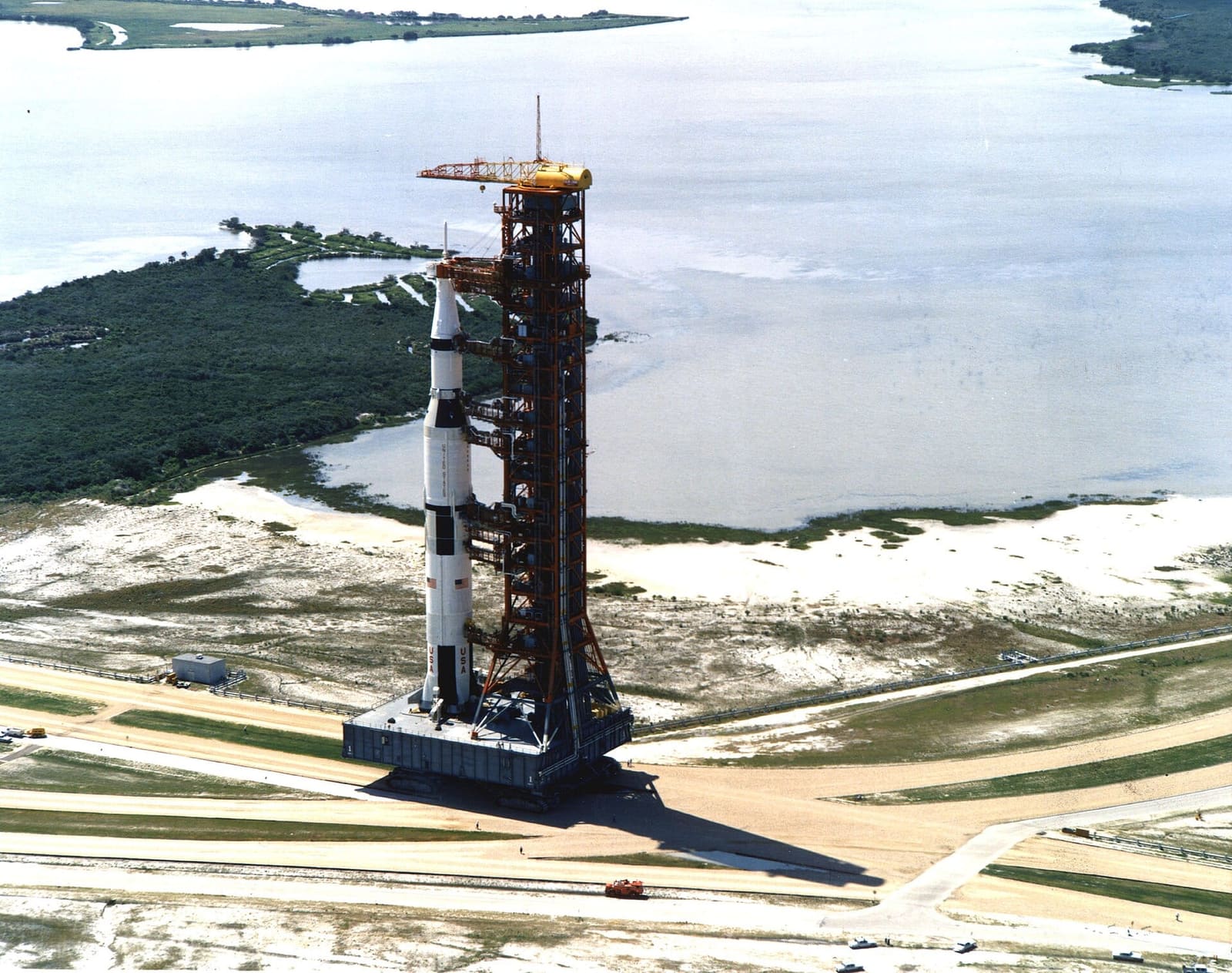
Brevard County had 23,653 residents in 1950, 111,435 in 1960, and 230,006 in 1970. The 1960-1970 doubling, adding nearly 119,000 people in a decade, is the largest percentage population growth in any Florida county’s history. The Apollo program drove it.
Then Apollo ended.
The buildup
Project Mercury, announced in 1958, brought the first wave of NASA personnel and contractors to Brevard. The pre-existing Air Force presence at Patrick AFB and the new Marshall Space Flight Center personnel rotating through the Cape kept the buildup steady through the early 1960s. The Saturn IB and Saturn V programs ramped up sharply after President Kennedy’s May 25, 1961 address committing the country to a lunar landing by decade’s end.
NASA’s Kennedy Space Center, formally established as the Launch Operations Center in 1962 and renamed Kennedy Space Center in 1963, peaked at roughly 26,500 employees in 1968. Of those, about 2,500 were federal civil servants; the rest were contractor employees of Boeing, North American, IBM, Grumman, Bendix, Wackenhut, and dozens of smaller firms. The KSC workforce overshadows the Patrick AFB and Cape Canaveral Air Force Station workforce by 3x in this period.
Total Brevard County employment in aerospace and related industries peaked around 32,000 in 1968. That single industry accounted for over 35 percent of all employment in the county.
What it built
The infrastructure buildout was enormous and fast. Between 1960 and 1970, Brevard built or expanded:
- Eight new public elementary schools, three new high schools.
- A new Brevard Community College (chartered 1960, opened 1962).
- The Florida Institute of Technology in Melbourne (chartered 1958 as Brevard Engineering College).
- Approximately 65,000 new housing units across Cocoa, Cocoa Beach, Merritt Island, Titusville, and the rapidly expanding Palm Bay and Melbourne areas.
- Three new sewage treatment plants and major expansions of municipal water supplies.
- A new SR 528 (the “Bee Line”) connecting Orlando to Cocoa, completed in segments 1963-1976.
- Substantial expansion of the Indian River causeways and barrier-island access bridges.
Brevard’s tax base went from $54 million in 1959 to over $1 billion by 1973 (1973 dollars). Sales tax receipts grew at an average 17 percent per year through the decade. The county did not borrow heavily, federal aerospace dollars flowing into local payrolls and retail spending paid for most of the buildout.
The bust
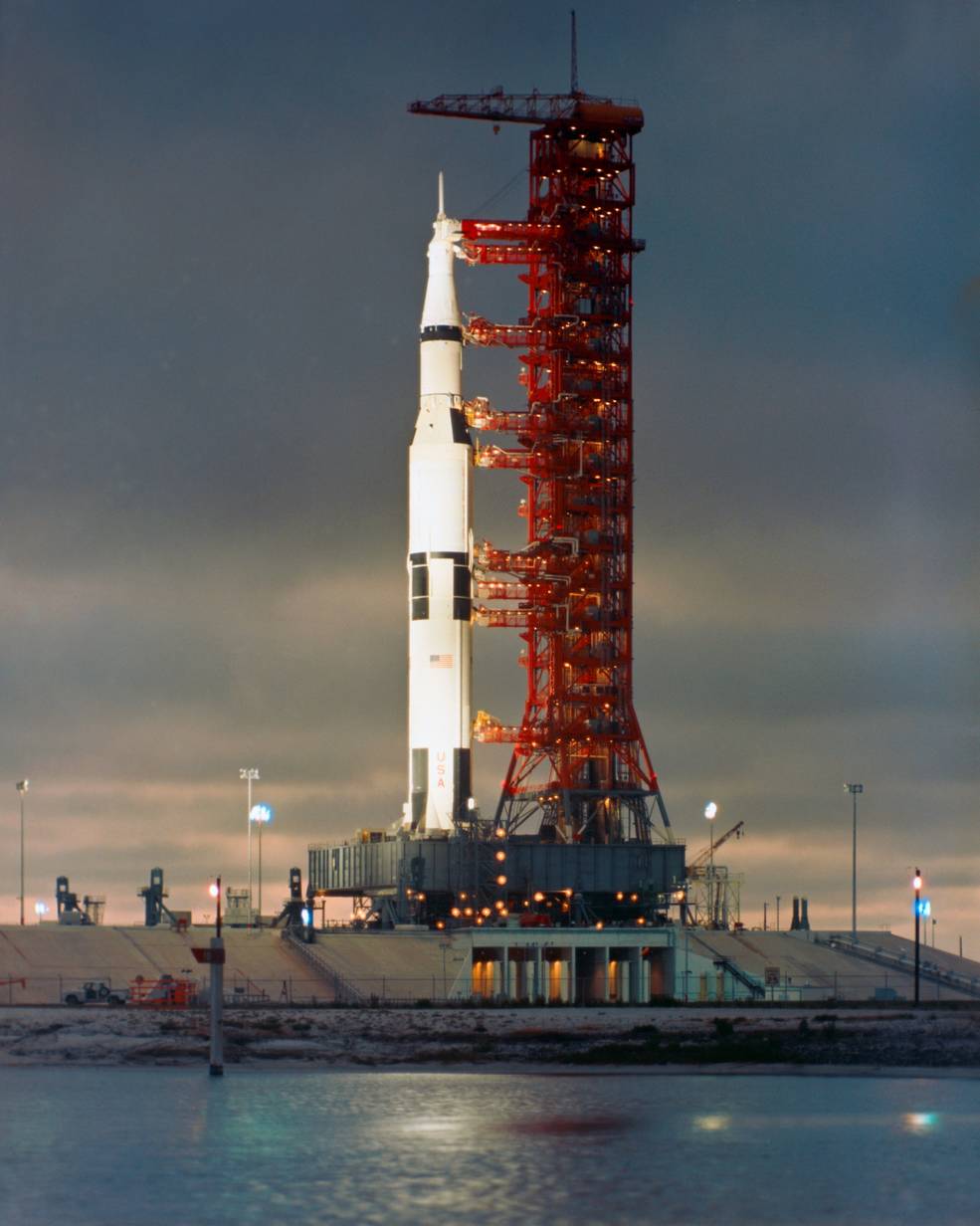
The Apollo program ended in December 1972 with Apollo 17. The Skylab program flew three crews in 1973-74, then the Apollo-Soyuz Test Project flew the last Saturn IB in July 1975. NASA’s KSC workforce dropped from 26,500 in 1968 to under 13,000 by 1976.
Brevard County lost approximately 30,000 to 35,000 jobs between 1969 and 1975, with the deepest cuts in 1971-1973. Aerospace employment dropped from 32,000 to roughly 10,000 over four years. Unemployment in Brevard peaked at over 15 percent in 1972, more than double the national rate at the time.
The retail and housing markets crashed. Houses in Cocoa Beach and Titusville sold for 40 to 60 percent below 1969 peaks. Several large subdivisions, particularly in Palm Bay and West Melbourne, sat half-built for years. Cocoa Beach’s motel industry, built for tourist traffic and the launch-spectator trade, lost about 30 percent of its inventory to closure between 1971 and 1975.
The 1973 oil embargo compounded the local pain. National recession plus regional industry collapse plus the cost of heating Florida snowbird homes that suddenly couldn’t sell, all hit Brevard simultaneously.
The migration
The aerospace workforce was mobile. Engineers and skilled technicians went where the work was. The major destinations of the 1971-1975 outflow were Huntsville, Alabama (Marshall Space Flight Center, still doing Saturn and Skylab work), Houston (Manned Spacecraft Center, transitioning to Shuttle planning), Los Angeles (Rockwell, lead Shuttle contractor), and Cape Kennedy itself for the surviving Shuttle preparation work.
Many didn’t leave Brevard. The local schools, weather, and quality of life kept families in place even as the breadwinner commuted or transitioned to other industries. The University of Central Florida (then Florida Technological University, opened 1968) and FIT became important re-employment paths, retraining laid-off aerospace workers for civil engineering, education, healthcare, and the emerging tourism industry around Walt Disney World (opened 1971 in Orlando).
The Shuttle reprieve
The Space Shuttle program, formally announced in 1972 and beginning operational launches from KSC in 1981, partially rebuilt the Brevard aerospace workforce. By 1985 KSC employment had recovered to roughly 18,000. The 1986 Challenger disaster, the 2003 Columbia disaster, and the Shuttle’s eventual retirement in 2011 each produced smaller versions of the 1971-75 contraction pattern.
The post-Shuttle period (2011-2015) saw the most recent major Brevard aerospace contraction. KSC employment dropped from approximately 15,000 in 2009 to under 8,500 in 2015. The unemployment in Titusville and Cocoa neighborhoods adjacent to KSC ran in the double digits for several years.
The post-2015 recovery, driven by the SpaceX and Blue Origin commercial launch buildouts, has restored most of those jobs by 2024. Brevard County aerospace employment in 2024 is approximately 16,000, close to the late-Shuttle peak, though distributed across a larger number of smaller employers.
What the boom-and-bust pattern teaches
The Apollo cycle was the first and largest of what is now a recurring Brevard rhythm. Major space programs build the local economy; major program transitions break it. Apollo to Skylab gap, Skylab to Shuttle gap, post-Challenger gap, post-Columbia gap, post-Shuttle gap. Each cycle has been smaller in absolute terms than the 1969-75 collapse, partly because the regional economy has diversified, tourism, healthcare, and education are now substantial employers, and partly because the space program itself runs on a steadier baseline than the Apollo crash program ever did.
What the Apollo era left Brevard, beyond the obvious physical infrastructure, was a community that knows what an aerospace contraction looks like. Local officials, business owners, and homeowner associations all carry the institutional memory. The 2025-26 SpaceX and Blue Origin buildouts are being absorbed with conscious caution, diversification incentives, requirements that new factories include non-aerospace component lines, careful management of housing supply to avoid the 1972 oversupply mistake. The county is no longer naive about the cycle. Whether that translates to actually softer landings the next time the cycle turns down is the test ahead.
Apollo’s national scale, Brevard’s local share
The national scale of Apollo, captured in NASA’s own program history, helps explain why Brevard’s local economy moved as fast as it did. At peak, the Apollo program employed approximately 400,000 people and required the support of over 20,000 industrial firms and universities. Charles Fishman’s One Giant Leap puts the figure at 410,000 men and women across roughly 20,000 different companies. Brevard’s 32,000 aerospace jobs in 1968 represented about 8 percent of the total Apollo workforce, concentrated in the launch operations end of the program (assembly, checkout, integration, range safety, telemetry) rather than the design and manufacturing end based at Marshall Space Flight Center in Huntsville, the Manned Spacecraft Center in Houston, and the contractor plants in southern California, Long Island, and St. Louis.
The total program cost was approximately $25 billion in 1973 dollars, equivalent to roughly $257 billion in 2020 terms. That made Apollo, in NASA’s own words, “the largest commitment of resources ever made by any nation in peacetime.” A significant fraction of that money flowed through KSC payroll into Brevard’s local economy. Sales tax receipts in Brevard tracked the federal aerospace appropriation almost line for line through the decade.
The von Braun pipeline, Huntsville to the Cape
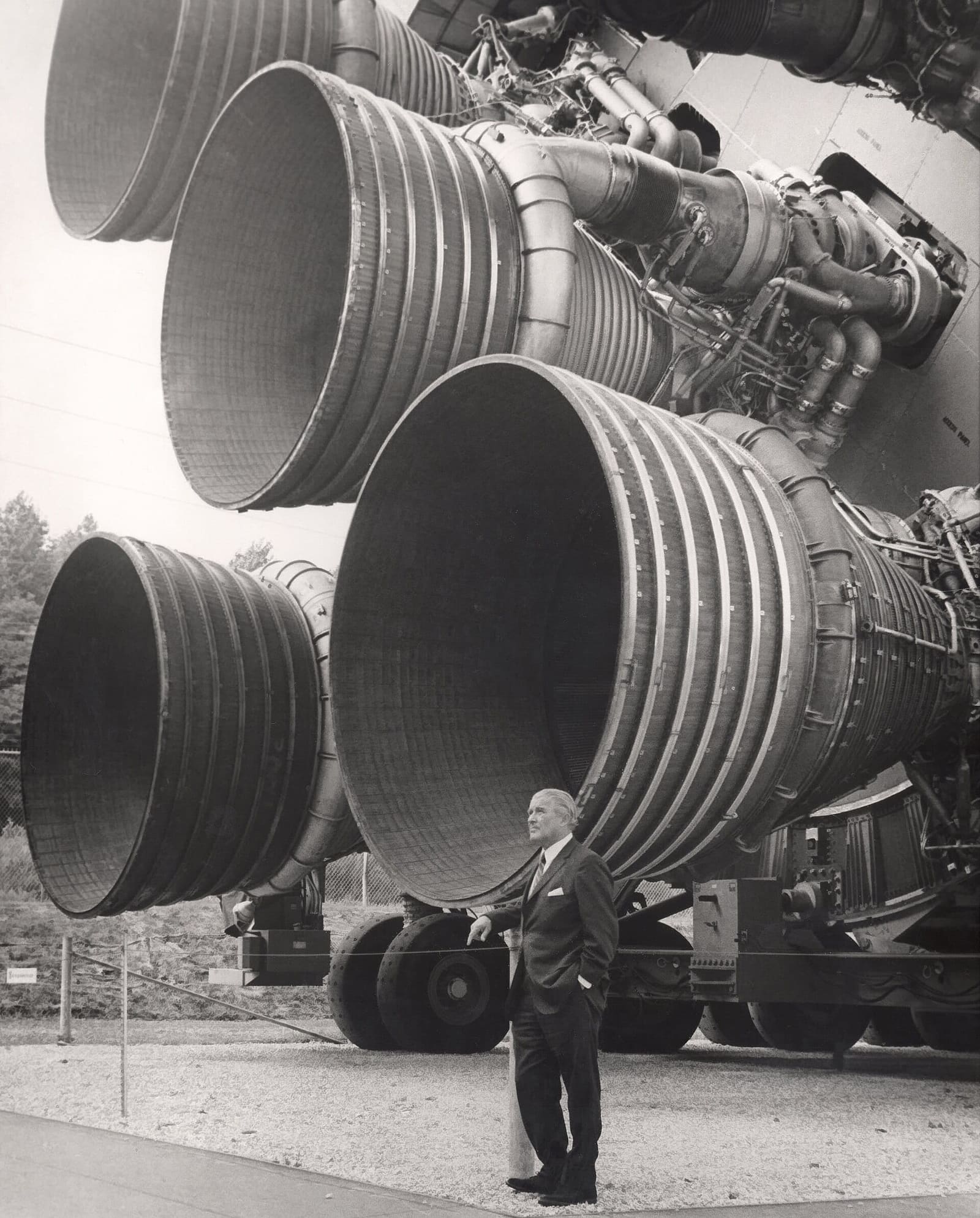
The skilled-workforce pipeline that staffed Brevard’s Apollo buildup did not originate locally. It began with the 130 German rocket engineers who arrived at Fort Bliss, Texas and the White Sands Proving Ground in New Mexico through late 1945 and early 1946 under Operation Paperclip, the US program that recruited over 1,600 German scientists from postwar Europe. On April 1, 1950, Wernher von Braun’s group of more than 130 Paperclip members transferred from Fort Bliss to Redstone Arsenal in Huntsville, Alabama. The Huntsville team built the Redstone, Jupiter, and eventually the Saturn family of rockets that powered every American crewed launch from 1961 to 1975.
The Huntsville-to-Cape pipeline carried that expertise into Brevard. NASA created the Marshall Space Flight Center at Redstone Arsenal in 1960 and put von Braun in charge. Marshall designed and built the Saturn vehicles; the Launch Operations Center at the Cape (renamed Kennedy Space Center in November 1963) assembled, checked out, and flew them. Engineers and technicians rotated between Huntsville and the Cape on every Saturn vehicle. When the Apollo program ended in 1972 and contracts in Brevard wound down, the reverse flow back to Huntsville absorbed several thousand of the laid-off aerospace workers, because Marshall continued Saturn-derived Skylab work through 1974 and Shuttle main-engine development through the late 1970s.
What Brevard did NOT build in the Apollo decade
The infrastructure inventory above lists what got built. What did not get built is at least as telling. Brevard did not get a passenger rail upgrade. The FEC line through Cocoa and Titusville carried freight only through the Apollo decade and remained freight-only until the Brightline expansion of the 2020s. Brevard did not get a major hospital expansion proportional to the population growth, the Wuesthoff Memorial Hospital in Rockledge stayed at roughly its 1950s capacity through 1972, and serious capacity expansion did not happen until the mid-1980s. Brevard did not get state university campuses, the closest UF and FSU branches were in Orlando and Tampa, leaving Florida Tech and Brevard Community College to handle higher education for a county adding 12,000 residents per year.
The infrastructure that did not get built is what made the bust so painful. A diversified economy needs medical, educational, and transit infrastructure to absorb workers when one industry contracts. Brevard’s late-1960s infrastructure was almost entirely aerospace-supporting: subdivisions for KSC contractors, schools for their children, roads to KSC. When KSC employment dropped 50 percent in four years, none of the inherited infrastructure had non-aerospace use. The 30-year recovery period that followed was partly about building the medical, retail, and educational base that Apollo-era planners had not prioritized.
Further Reading
As an Amazon Associate we earn from qualifying purchases.